 Bottle feeding help? How can you make bottle feeding and breastfeeding work well together? Keep breastfeeding the baby on demand when you are home with them! Use paced bottle feeding.
There are so many questions, though! Here are some examples:
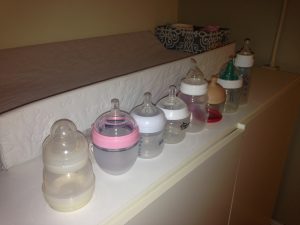
Question: Which bottle should I use?
Answer: How you bottle-feed seems to be more important than the actual bottle nipple shape. But it seems that using a slower-flow nipple with a cone shape best mimics breastfeeding and encourages good feeding function.
Question: What about nipple confusion? How should you give a bottle?
Answer: We now think that babies actually develop flow preference, not nipple confusion in most cases. If the baby needs to just swallow and do no work, and if they get to eat really, really fast while bottle feeding, they may lack the patience for breastfeeding. Paced bottle feeding seems to be the key!
Question: What about swallowing too much air in when you use paced bottle feeding?
Answer: You swallow far more air while gulping than while sipping. Paced bottle feeding lets you sip instead of gulp! Think about when you need to burp. Sipping tea or chugging a drink?
Question: How long can I store breast milk?
Answer: The rule of thumb is about 4-6 hours at room temperature, 4-8 days in the refrigerator, and 6 months in a seperate freezer. If you are worried about your breastmilk being fresh, sniff it! We all know what spoiled milk smells like!
This next section answers many of the most commonly asked questions, including how much should be in each bottle. How many bottles does the baby need? How much should a baby eat in 24 hours?
A healthy baby usually needs about 2.5 oz per lb of their weight per 24 hours up until they reach about 10ish pounds. This amount of total intake does not increase after about 25-30 oz per day! On average, babies eat about 25 oz per 24 hours worldwide.
Really! This is true! Whether they are breastfeeding, breast milk feeding, or shockingly, formula feeding! If you are feeding your baby more than 25ish oz per 24 hours, you might want to think about paced bottle feeding. Research says if you feed too fast, you are setting the baby up for overeating and obesity later in life.
If your baby is little and you need to supplement, take the baby’s weight in pounds and multiply that number by 2.5 oz to get the total amount of food needed for 24 hours.
For example, a 6-lb baby needs to eat about 15 oz over 24 hours. 6 X 2.5 = 15. If the baby eats about 10 times in 24 hours, they would need about 1.5 oz per bottle.
Make sense? However, we always listen to hunger cues as our bottom line. If we use paced bottle feeding and the baby seems to want a little bit more, give it to them! Have weight checks every few weeks to make sure your baby is gaining about 1 oz per 24 hours for the first 4 months and about 1/2 oz per 24 hours after 4 months.
How Much Do You Feed Your Baby When You Are Away?
People often ask how many bottles a baby needs and how much to put in each bottle for each feed. of all, calculate how many ounces the baby needs in 24 hours. As stated, babies need about 2.5 oz per lb of their weight per 24 hours. This total intake does not increase beyond about 25-30 oz.
Count how many feedings a day your baby has in total when you are home with him for a full day. Divide 28 oz by that number. That is about the number of oz they will need per feed in each bottle.
Count how many breastfeeds the baby will miss while you are gone. This is about how many bottles the baby will need. Consider making several small bottles instead of a few large bottles. Most babies will eat 2-4.5 oz per feed (depending on age). If your baby is eating more than 5 oz per feed, they are likely overeating at each feeding. Go back to Paced Bottle Feeding. Try replacing the nipple. Your old nipple may have gotten too stretched.
Feeding amounts:
25 oz divided by # of feeding per day roughly = how much in each bottle
# of feeds the baby will miss = # of bottles to send.
Remember, these are rough calculations. Please send a few 1-oz snack bottles in case the baby needs a bit more food during a particular feed.
If you work with breast/chestfeeding families and are passionate about lactation support, or you want to turn your passion for nursing into professional practice, check out LactaLearning.com and consider following us on social media!
Instagram @lacta.learning
Facebook LactaLearning